 Grosser Erfolg fuer die Kachelforschung: Die Ausgrabungen in der Jesuitensiedlung Trinidad im Sueden Paraguays zeigen, dass bereits im 18. Jahrhundert und unter Anleitung der spanischen Moenche kunstvolle Kacheln gebrannt und verlegt worden sind (siehe Foto). Nachdem die Jesuiten im Jahr 1767 endgueltig aus Suedamerika vertrieben wurden, duerfte sich das Wissen um das "Keramik-Gold" von hier aus weiter auf dem Kontinent ausgebreitet und Eingang in die Populaerkultur des Cono Sur gefunden haben. Ausserdem zeigen die Fundstuecke auf beeindruckende Art und Weise, dass sich die lateinamerikanische Kachelkultur bereits in ihren Anfaengen durch ihren Farbenreichtum und ihre kreative Verwendung von ihrer europaeischen Herkunft geloest hat und als eigensteaendige Gattungsform verstanden werden muss.
 25.10.08
Lateinamerikanische Kacheln: Ein Erbe der Jesuiten?
Grosser Erfolg fuer die Kachelforschung: Die Ausgrabungen in der Jesuitensiedlung Trinidad im Sueden Paraguays zeigen, dass bereits im 18. Jahrhundert und unter Anleitung der spanischen Moenche kunstvolle Kacheln gebrannt und verlegt worden sind (siehe Foto). Nachdem die Jesuiten im Jahr 1767 endgueltig aus Suedamerika vertrieben wurden, duerfte sich das Wissen um das "Keramik-Gold" von hier aus weiter auf dem Kontinent ausgebreitet und Eingang in die Populaerkultur des Cono Sur gefunden haben. Ausserdem zeigen die Fundstuecke auf beeindruckende Art und Weise, dass sich die lateinamerikanische Kachelkultur bereits in ihren Anfaengen durch ihren Farbenreichtum und ihre kreative Verwendung von ihrer europaeischen Herkunft geloest hat und als eigensteaendige Gattungsform verstanden werden muss. 
20.10.08
Changing Paraguay
After half a year, I returned to Paraguay to visit various places of  volunteers and met a changing country. As one hoped in March, Fernando Lugo won the elections in april and for the first time since 61 years broke with the rule of the Colorado party, which was responsible not only for dictaturships like the one of Stroessmer (54-89) but also has established a wide system of corruption throughout the whole private and public business and administration.
Now, the former catholic bishop is confrontated with big hopes and expections: Increase the wealth of the paraguayan people (BNP abot 9.000 US$/year), decrease the poverty rate which lays close to 40%, help that all children get acess to education (one third stops to visit schoo, after one year) etc. etc. This all might not work without touching the privileges of Paraguay´s oligarcy. 1% of the population owns 75% of the country, among them many of German and Brasilian decent, earning good money with soja, mais and other agricultural products destinied for export.
 volunteers and met a changing country. As one hoped in March, Fernando Lugo won the elections in april and for the first time since 61 years broke with the rule of the Colorado party, which was responsible not only for dictaturships like the one of Stroessmer (54-89) but also has established a wide system of corruption throughout the whole private and public business and administration.
Now, the former catholic bishop is confrontated with big hopes and expections: Increase the wealth of the paraguayan people (BNP abot 9.000 US$/year), decrease the poverty rate which lays close to 40%, help that all children get acess to education (one third stops to visit schoo, after one year) etc. etc. This all might not work without touching the privileges of Paraguay´s oligarcy. 1% of the population owns 75% of the country, among them many of German and Brasilian decent, earning good money with soja, mais and other agricultural products destinied for export.
It is a question wether Lugo is able to find solutions in and with this harshly segregrated society. 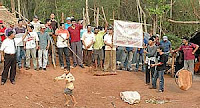 The conflicts yet started to become violently. In one of the provinces a leftist group of the landless (sintierras) started to use weapons to occupy land of the big landowners and even more, issued an ultimatum to the "Braziguayos" (how they call the Brazilian owners) to leave the province till the end of the month. If not, they are willing to expell them violently. Of course, the answer of the landlords is not calm either, already a few of the activists died after the use of firearms of the owners. Another thread comes from the neighbouring Brazil (although president Lula da Silva is known to be maybe the most powerful men of the leftist movement in Latinamerica´s governments) . In a step which hardly supports the government of Lugo, the Brazilian army started to do trainings in the region of Iguazu. Not only to support the Brazilian citizens in Paraguay, all commentators see it as a strong message against the renegotiation of the power plant contract of Iguazu. These gigantic water plants are constructed by Argentina, Brazil and Paraguya and although the biggest part of them are located on the Paragauyan side, only the smallest percentage of the income goes to Paraguay.
 The conflicts yet started to become violently. In one of the provinces a leftist group of the landless (sintierras) started to use weapons to occupy land of the big landowners and even more, issued an ultimatum to the "Braziguayos" (how they call the Brazilian owners) to leave the province till the end of the month. If not, they are willing to expell them violently. Of course, the answer of the landlords is not calm either, already a few of the activists died after the use of firearms of the owners. Another thread comes from the neighbouring Brazil (although president Lula da Silva is known to be maybe the most powerful men of the leftist movement in Latinamerica´s governments) . In a step which hardly supports the government of Lugo, the Brazilian army started to do trainings in the region of Iguazu. Not only to support the Brazilian citizens in Paraguay, all commentators see it as a strong message against the renegotiation of the power plant contract of Iguazu. These gigantic water plants are constructed by Argentina, Brazil and Paraguya and although the biggest part of them are located on the Paragauyan side, only the smallest percentage of the income goes to Paraguay.
Despite all the open questions, Lugos presidency is a step forward in a country which has deeply sunk in corruption and undemocratic practises. After his 2 months of presidency, Lugo obviously searched the way for peaceful dialogue, now it is up to the society to share this path.
05.10.08
Homosexuality in a religios world
Due to some physical handicaps I unfortunatly was not able to visit two project's events on the weekend, instead I had to lay on the terrace in the sun, learning some spanish, writing mails, eating strawberries. How sad!
Even more happily, since just in time on this saturday, there was a queer event taking place in the ISEDET - although its really hard to believe for anybody who is living here. So I did not have to move a lot to get in contact with an activist group of queer rights, the Cegla Argentina, which is formed by gay, lesbian and other queer cristians. Quite a big topic in a world which is much more formed by religion and religios conservatism then most of European places. While it's obvious what's the catholic point of view, here, also the evangelical churches think in their majority of homosexuality being a sin or at least the conduction of it. Many of them might be even stricter then the often laissez-faire day-to-day life in catholic congregrations. Especially the big movements from the US, the Pentecostal churches, but also other "historical" protestant churches formulate a hard standpoint. Among some popular answers on homosexuality, one can get healed from the demon directly in some services in Buenos Aires or participate in a group of Exodus International ("freedom is possible").
In this cultural context, the church I am working for, the IERP, can surely be seen to be one of the most liberal evangelical churches in Latinamerica. Nevertheless, so far it also followed the strategy of the three apes and never stated a clear opinion on the issue of homosexuality. Now time has to change. The case of an openly gay vicar, has forced the IERP to work in an official comission on the issue. While it might just serve to delay any answer, or even worse, state against homosexuality, my hope is, that they find a way to open the doors to the queer folk . It would be the first official statement of evangelical churches in the cono sur of the issue.
But back to the movie night: Astonishing many people were visiting the movie, and while looking around I couldn't help but wonder, that there were obviously some people in my religios sourrounding being more attached to the issue then I ever expected. To me it demonstrated that church, maybe due to Jesus' central message of love, has always attracted also the queers. Even more impressive was a second situation that night. I talked to one of my housemates about the movie. After watching the sad and at the same time optimistic stories of 4 cristian families in the US struggling with a homosexual child, she told me that yes, its a good movie, but she is still not quite convinced that homosexuality really could not be a sin. With all my commitment to the issue, I first thought that she makes an ironical joke. Well, but after talking a bit more, it turned out to be her serios thinking. Confrontated with varios forms of homophobia in my life, from violent aggression in Cologne to right wing confrontations in Krakow, that was the first time that I met somebody being so formed by its cultural background, that their was simply no doubt in stating something like that. Wow. It might be a good example for the conservative parts of my sourrounding here. Afterwards I told her about my own orientation and I am sure their will be some more dialogue in these days about the topic. As well, as in the commission of the IERP. And I will keep you informed!
Even more happily, since just in time on this saturday, there was a queer event taking place in the ISEDET - although its really hard to believe for anybody who is living here. So I did not have to move a lot to get in contact with an activist group of queer rights, the Cegla Argentina, which is formed by gay, lesbian and other queer cristians. Quite a big topic in a world which is much more formed by religion and religios conservatism then most of European places. While it's obvious what's the catholic point of view, here, also the evangelical churches think in their majority of homosexuality being a sin or at least the conduction of it. Many of them might be even stricter then the often laissez-faire day-to-day life in catholic congregrations. Especially the big movements from the US, the Pentecostal churches, but also other "historical" protestant churches formulate a hard standpoint. Among some popular answers on homosexuality, one can get healed from the demon directly in some services in Buenos Aires or participate in a group of Exodus International ("freedom is possible").
In this cultural context, the church I am working for, the IERP, can surely be seen to be one of the most liberal evangelical churches in Latinamerica. Nevertheless, so far it also followed the strategy of the three apes and never stated a clear opinion on the issue of homosexuality. Now time has to change. The case of an openly gay vicar, has forced the IERP to work in an official comission on the issue. While it might just serve to delay any answer, or even worse, state against homosexuality, my hope is, that they find a way to open the doors to the queer folk . It would be the first official statement of evangelical churches in the cono sur of the issue.
But back to the movie night: Astonishing many people were visiting the movie, and while looking around I couldn't help but wonder, that there were obviously some people in my religios sourrounding being more attached to the issue then I ever expected. To me it demonstrated that church, maybe due to Jesus' central message of love, has always attracted also the queers. Even more impressive was a second situation that night. I talked to one of my housemates about the movie. After watching the sad and at the same time optimistic stories of 4 cristian families in the US struggling with a homosexual child, she told me that yes, its a good movie, but she is still not quite convinced that homosexuality really could not be a sin. With all my commitment to the issue, I first thought that she makes an ironical joke. Well, but after talking a bit more, it turned out to be her serios thinking. Confrontated with varios forms of homophobia in my life, from violent aggression in Cologne to right wing confrontations in Krakow, that was the first time that I met somebody being so formed by its cultural background, that their was simply no doubt in stating something like that. Wow. It might be a good example for the conservative parts of my sourrounding here. Afterwards I told her about my own orientation and I am sure their will be some more dialogue in these days about the topic. As well, as in the commission of the IERP. And I will keep you informed!
01.10.08
Schland ist ueberall
Da die Welt in dieser Nacht mit 700 Milliarden fuer die Banken gerettet wurde, koennen wir uns beruhigt wieder den kulturellen Themen widmen. Sollte sich jemand Gedanken machen, in welcher Wildnis ich mich herum treibe: 2 Videos sollen der Aufklaerung dienen. Der freundliche Herr, der in Carmen Nebels Weihnachtsgala 2 Saetze ueber Gewalt sagen darf (nein, nicht der Stimmgabelpreistraeger Semino Rossi) ist mein Chef Jorge Gerhard. Wenn er sich nicht grade auf Werbetour in Deutschland befindet, sitzt er hinter mir im Buero und macht Voelkerverstaendigung am Telefon. Auch wenn er nicht immer mit Pastorenkragen herum laeuft, sollte klar werden: Diesem Mann kann man trauen! Aufschlussreich auch das zweite Video, das echte lateinamerikanische Froehlichkeit beim Gemeindefest am letzten Sonntag in Belgrano einfaengt. Leider war die Kamera noch nicht griffbereit, als die Volkstanzgruppe mit schwarz-rot-goldenen Baendchen im Haar geschuhplattlert hat. Achso, Belgrano liegt uebrigens 12.000 Kilometer vom Westerwald entfernt! Hatte ich schon erwaehnt, dass ich fuer eine Kirche der deutschen Einwanderer arbeite? Und dass die USA jaehrlich 16 Milliarden fuer die Entwicklungshilfe ausgeben?
28.09.08
Springtime in Urdi
Yuh, that were busy first weeks in Argentina and not at all the most interesting ones - sitting behind the computer, writing mails about flats, bank acounts and matraces. But now, starting work is done and it becomes a bit more relaxed and interesting. And: While you in Europe are suffering a rainy autumn, here springtime started on the 21st of september. A day were Argentine Youth is said to get drunk and have orgies in the park. Of course I was trying to see that, but it was a big exaggeration. There were some hipie musicians and a very peaceful crowd, Rock `n Roll looks different to me.

 Two days later appaered the sun, indeed, and now the temperatures already climb up to 20 degress during the day. Time to leave the grey city and the computer behind and go to the countryside! My first volunteer visit brought me to Urdianarrain, just 5 hours away from Buenos Aires, a small village of 8000 inhabitants and amazing middle class atmosphere - due to the soya, of course. While the government decided to close down all children homes of the country, the two volunteers in the home of Urdinarrain, Max and Johannes, seemed to be in danger of having no work. Yet finally it turned out that the new start of the institution is already made. The now day care center for kids offers enough work for both, like mental math, knitting and slaughtering (the cows, not the kids). In Urdi, I also had the first nights without street noise and a sky sprangled with stars! By the way, none of the important banks for Argentina got bankrupt so far. Seems that the bigger crises at the moment are in different regions. Here, we will enjoy the sun!

 Two days later appaered the sun, indeed, and now the temperatures already climb up to 20 degress during the day. Time to leave the grey city and the computer behind and go to the countryside! My first volunteer visit brought me to Urdianarrain, just 5 hours away from Buenos Aires, a small village of 8000 inhabitants and amazing middle class atmosphere - due to the soya, of course. While the government decided to close down all children homes of the country, the two volunteers in the home of Urdinarrain, Max and Johannes, seemed to be in danger of having no work. Yet finally it turned out that the new start of the institution is already made. The now day care center for kids offers enough work for both, like mental math, knitting and slaughtering (the cows, not the kids). In Urdi, I also had the first nights without street noise and a sky sprangled with stars! By the way, none of the important banks for Argentina got bankrupt so far. Seems that the bigger crises at the moment are in different regions. Here, we will enjoy the sun!
10.09.08
OTRA!

In dem Haufen bin ich in der letzten Woche gelandet! Unverkennbare Fruehlingssonne, im Hintergrund mein Domizil das ISEDET, und im Vordergrund geschaetzte 45 Freiwillige, von denen viele "weltwaerts" unterwegs sind. Gemeinsam werden wir versuchen heraus zu bekommen, was ein Jahr entwicklungspolitischer Freiwilligendienst bringen kann.
Und an euch alle: Willkommen zurueck bei der Kachelsafari in Suedamerika!
Und an euch alle: Willkommen zurueck bei der Kachelsafari in Suedamerika!
29.06.08
Adios Argentina y hasta luego!
 Zum guten Schluss: So sieht sie eigentlich aus, meine Arbeit in Argentinien! 30 Langzeit- freiwillige im Jahr 2007/2008, die durch und bei der IERP in einem sozialen Projekt in Argentinien, Paraguay und Uruguay ableisten. Hier sind wir gemeinsam auf dem Abschlussseminar der IERP in der letzten Woche und auch fuer mich hiess es danach erstmal Abschied nehmen von Argentinien.
In den naechsten 2 Monaten freue ich mich im schwarz-rot-goldene Sommer-Sonnen-
Gartengrill Deutschland zu sein und darauf, den ein oder andern von euch zu sehen! Aber, um der Welt noch weitere beeindruckende Aufnahmen suedamerikanischer Kachelkunst zu verschaffen, habe ich mich entschieden, am 30. August zurueck zu gehen und den naechsten Jahrgang IERP-Freiwilliger zu betreuen. Dann geht es also weiter mit Asado, Alfajores und Azulejos, mehr Christina, Campo und Chaco und garantiert mit noch mehr Uruguay und richtigen Indianern!
Gartengrill Deutschland zu sein und darauf, den ein oder andern von euch zu sehen! Aber, um der Welt noch weitere beeindruckende Aufnahmen suedamerikanischer Kachelkunst zu verschaffen, habe ich mich entschieden, am 30. August zurueck zu gehen und den naechsten Jahrgang IERP-Freiwilliger zu betreuen. Dann geht es also weiter mit Asado, Alfajores und Azulejos, mehr Christina, Campo und Chaco und garantiert mit noch mehr Uruguay und richtigen Indianern!
In diesem Sinne verabschiede ich mich in die Sommerpause und freu mich, wenn ihr im Herbst wieder auf dem Kachelagenten vorbei schaut! Nos vemos en Septiembre!
Ugi´s grosse Mozarella jetzt 10 Peso!
 Wie man Ugi´s grosse Mozarella als Inflationsindikator benutzen kann, hat die TAZ herausgefunden. Den unbedingt lesenswerten Artikel über die derzeitige ökonomische Situation in Argentininen (danke Tina!) könnt ihr hier anklicken. Anbei das Foto als Beweis. Und wer in garantiertem Kachelumfeld in Buenos Aires satt werden will, dem sei Ugi´s trotz der gestiegenen Preise empfohlen.
16.06.08
Current Castellano: Campo, Paro, Piqueteros
Since 95 days, Argentina is now struggling with a conflict between the so said "campo" (country) and the government. Essentially in opposition of higher tariffs on soya exports, for the third time in the last 4 months the farmers are on strike (paro), with again blocading the streets of Argentina (as piqueteros). The whole society is effected by it, for the second time (fresh) food and fuels become scarce in some provinces, public transport between the provinces is hardly posible, and even more feared: the inflation rate rises more and more. Most of all effected by that are the poor parts of Argentine's society. A solution is not in sight, the government rejects to talk with the country leaders until they don't stop the strike and the country isn't satisfied with the so far by the government decided reliefs on the tariffs.
 In the atmosphere of high tention, the picture potraits the maybe biggest escalation so far, the detention of Alfredo de Angeli. Yesterday, the government decided to send the police to end the blocades and the most important leader of the countrie's protest went to custady for some hours. New protests rose and also the peronist government started to mass mobilize its supporters again.
From my point of view, the tariffs could be one element to ease the countries immense economical unequality. With the fastly growing international prices for soya, some 10% of the land owners are earning 75% of the soya profit and certainly earning more then ever before. Regarding that, to speak of the "country" is not possible. But what could be part of intelligent social policy, is at the moment endangered to become a farce. Evita like, last monday the president declared to build 30 hospitals with the profit of the tariff, streets and health centers, widely commented with ridicule and distrust. The growing escalation shifts the view far from the real causes and at the moment, the social peace of the society in total is deeply in danger.
What's the worst: The conflict is caused by the rich countries hunger for alternative fuels and meat. 95% of the soya is produced for the export, ending up in the cars and pigs of Europe and more and more in China. Growing much during the last years, in 54% of Argentina's cultivated countryside the farmers grow (genetically manipulated) soya today. With all the negative consequenses for the environment and the smallholders. In its routs, the conflict in Argentina is higly caused in Europe. Much more would be to say about it and I deeply hope that there will be a solution before I leave the country in 8 days. Whats again my privelege: Flying to the rich north ever will be possible .
 In the atmosphere of high tention, the picture potraits the maybe biggest escalation so far, the detention of Alfredo de Angeli. Yesterday, the government decided to send the police to end the blocades and the most important leader of the countrie's protest went to custady for some hours. New protests rose and also the peronist government started to mass mobilize its supporters again.
 From my point of view, the tariffs could be one element to ease the countries immense economical unequality. With the fastly growing international prices for soya, some 10% of the land owners are earning 75% of the soya profit and certainly earning more then ever before. Regarding that, to speak of the "country" is not possible. But what could be part of intelligent social policy, is at the moment endangered to become a farce. Evita like, last monday the president declared to build 30 hospitals with the profit of the tariff, streets and health centers, widely commented with ridicule and distrust. The growing escalation shifts the view far from the real causes and at the moment, the social peace of the society in total is deeply in danger.
What's the worst: The conflict is caused by the rich countries hunger for alternative fuels and meat. 95% of the soya is produced for the export, ending up in the cars and pigs of Europe and more and more in China. Growing much during the last years, in 54% of Argentina's cultivated countryside the farmers grow (genetically manipulated) soya today. With all the negative consequenses for the environment and the smallholders. In its routs, the conflict in Argentina is higly caused in Europe. Much more would be to say about it and I deeply hope that there will be a solution before I leave the country in 8 days. Whats again my privelege: Flying to the rich north ever will be possible .
ESMA
 Samstag im ESMA, der zentralen Erinnerungsstaette an die Militaerdiktatur ab 1976. Auf dem ehemaligen Kasernengelaende der Marine mitten in Buenos Aires befindet man sich im Inneren der dunklen lateinamerikanischen Geschichte, die doch verdammt vetraut erscheint. Geschaetzte 5000 Menschen sind durch das groesste Folter- und Gefangenenzentrum geschleust worden, nur wenige von ihnen sind heute noch am Leben. Das Esma war zentrale Infomations- und Sammelstelle des geheimen Plans der Militaers im stilisierten Buergerkrieg gegen die Kommunisten und Staatsfeinde. Wie in den anderen geheimes Folterzentren, sind hier Keller und Dachboeden umgebaut, Fotostudios, Archive und Faelscherstudios eingerichtet worden, nicht zuletzt die Folterkammern der Militaers. Von hier aus sind die Gefangenen betaeubt in Flugzeuge gefuehrt und ueber dem Atlantik abgeworfen worden. Etwa 30.000 Menschen sind in der Zeit so oder anders ermordert worden. Auch Nicaragua taucht wieder auf. Wie im Plan Condor mit den benachbarten Diktaturen Geheimdienstinformationen ueber Staatsfeinde und Foltermethoden ausgetauscht wurden, sind auch die Militaers der Contras im ESMA ausgebildet worden. 2007 ist das ESMA als Erinnerungszentrum eingeweiht worden, heute sollen nicht nur die historischen Folterstaetten der Oeffentlichkeit zugaenglich gemacht, sondern auch die verschiedenen Gebaeude in den Dienst von Menschenrechtsorganisationen gestellt werden.
11.06.08


It was the touristy weekend, which I started thursday to saturday in Mar del Plata. Its the place were all porteños get jealous when you mention the trip, wish you lots of fun, long nights, some beautiful pickups... They usually hang around of what is called the beach of Buenos Aires with the other millions of visitors during the summer. But while winter started in Argentina, Sven - the volunteer who works for the reformed church here - the sea lions and me were almost alone at the beach. And since swimming was no option, we were working in the soupkitchen of one of Sven´s projects: 1000 pizzas, for about 500 families. Wow, impressive and very concrete social work!
The other impression shows the Argentine alternative to the Cologne cathedral: LUJAN! With big letters since its so important for the country. Established in 1873 , unbelievably old for local conditions, it saw mass prayings during the dictaturship, the pope in the 80ies and last but not least, a big number of miracles done by the VIRGIN of Lujan. The picture beside shows the real magic: Silvia and Jürgen (left and right) are German dropouts. Aged 50something they decided a few month ago to leave Germany, family, job and village, sell everything and go to Argentina to start one more time. Without a certain destination, without speaking spanish, without a job offer. Today, Jürgen´s working as bricklayer(his trained profession) at the nations sanctum and at least the next decade, they like to stay. In the middle you see Celina, my former Spanish teacher, who, sensitivly noticing some connection, brought us all together.
The other impression shows the Argentine alternative to the Cologne cathedral: LUJAN! With big letters since its so important for the country. Established in 1873 , unbelievably old for local conditions, it saw mass prayings during the dictaturship, the pope in the 80ies and last but not least, a big number of miracles done by the VIRGIN of Lujan. The picture beside shows the real magic: Silvia and Jürgen (left and right) are German dropouts. Aged 50something they decided a few month ago to leave Germany, family, job and village, sell everything and go to Argentina to start one more time. Without a certain destination, without speaking spanish, without a job offer. Today, Jürgen´s working as bricklayer(his trained profession) at the nations sanctum and at least the next decade, they like to stay. In the middle you see Celina, my former Spanish teacher, who, sensitivly noticing some connection, brought us all together.
24.05.08
Bici loca
Drei Tage auf dem Fahrrad in Buenos Aires! WAHNSINN. Mit meinem Rennschlitten aus dem Hause Nodari habe ich mir einen Traum erfuellt! Die Stadt ist komplett flach, fuer den Bus braucht man die raren Monedas (siehe unten), Taxi ist zu teuer und die Eroeffnung der U-Bahn-Station Flores verzoegert sich seit einem Jahr. Voller Glueck radel ich also ab jetzt durch Capital.
 Allerdings: Der Verkehr in Buenos Aires ist so schlimm, wie man es von anderen Grossstaedten immer behauptet. Nur, dass es hier stimmt. Es gibt markierte Spuren (meistens 6), die niemand beachtet. Stattdessen werden konsequent die Luecken ausgefuellt, um schneller zu sein als die anderen. Mit dem Fahrrad muss man ganz links fahren. Faehrt man ganz rechts ,ist es auch nicht schlimm. Blinker kommen in der Fahrausbildung nicht vor. Fahrausbildungen sind die Ausnahme. 20% der Autos faehrt ohne Licht. Die Vorfahrtsregelungen verstehe ich nicht (Vorfahrtsregelungen?). Deswegen halte ich lieber. Oder bewege mich als Fussgaenger ueber eine Kreuzung. Schoen ist, dass das Fahrrad keine Ausstattung braucht. Auch die Polizei auf dem Fahrrad (das gibt es!) faehrt ohne Licht.
Nach einer ersten Probe am Mittwoch (Glueck! Seeligkeit!) gestern dann der erste laengere Weg zu meiner Spanischlehrerin. Kein Problem, ist doch die ganze Stadt nach dem Schachbrettprinzip aufgebaut und deswegen leicht zu ueberblicken. Ich kalkulierte 30 Minuten. Anderthalb Stunden spaeter erreichte ich mein Ziel. Und hatte meine ersten wichigen Lektionen gelernt. Nicht alle Wege sind rechtwinklig, einige fuehren leicht diagonal zu komplett anderen Vierteln in der Stadt. Faehrt man auf der linken Seite, wird rechts Abbiegen zu einer besonderen Herausforderung. Manchmal landet man mitten im fliessenden Verkehr und alle Autofahrer foerdern einen freundlich hupend dazu auf, doch wieder auf den Bus umzusteigen. Kleinere Strassen sind nicht unbedingt die besser Wahl. Fahren dort Collectivos, muss man genuegend Gelassenheit fuer die Kraftprobe "ich oder der Bus" aufbringen.
Dennoch: Ich bin mir sicher, dass das Fahrrad die bessere Wahl ist! Grade haben die Bauern wieder angefangen die Strassen zu besetzen. Und auf zwei Raedern werde ich auch um Traktoren und Maehdraescher drumrum kommen.
 Allerdings: Der Verkehr in Buenos Aires ist so schlimm, wie man es von anderen Grossstaedten immer behauptet. Nur, dass es hier stimmt. Es gibt markierte Spuren (meistens 6), die niemand beachtet. Stattdessen werden konsequent die Luecken ausgefuellt, um schneller zu sein als die anderen. Mit dem Fahrrad muss man ganz links fahren. Faehrt man ganz rechts ,ist es auch nicht schlimm. Blinker kommen in der Fahrausbildung nicht vor. Fahrausbildungen sind die Ausnahme. 20% der Autos faehrt ohne Licht. Die Vorfahrtsregelungen verstehe ich nicht (Vorfahrtsregelungen?). Deswegen halte ich lieber. Oder bewege mich als Fussgaenger ueber eine Kreuzung. Schoen ist, dass das Fahrrad keine Ausstattung braucht. Auch die Polizei auf dem Fahrrad (das gibt es!) faehrt ohne Licht.
Nach einer ersten Probe am Mittwoch (Glueck! Seeligkeit!) gestern dann der erste laengere Weg zu meiner Spanischlehrerin. Kein Problem, ist doch die ganze Stadt nach dem Schachbrettprinzip aufgebaut und deswegen leicht zu ueberblicken. Ich kalkulierte 30 Minuten. Anderthalb Stunden spaeter erreichte ich mein Ziel. Und hatte meine ersten wichigen Lektionen gelernt. Nicht alle Wege sind rechtwinklig, einige fuehren leicht diagonal zu komplett anderen Vierteln in der Stadt. Faehrt man auf der linken Seite, wird rechts Abbiegen zu einer besonderen Herausforderung. Manchmal landet man mitten im fliessenden Verkehr und alle Autofahrer foerdern einen freundlich hupend dazu auf, doch wieder auf den Bus umzusteigen. Kleinere Strassen sind nicht unbedingt die besser Wahl. Fahren dort Collectivos, muss man genuegend Gelassenheit fuer die Kraftprobe "ich oder der Bus" aufbringen.
Dennoch: Ich bin mir sicher, dass das Fahrrad die bessere Wahl ist! Grade haben die Bauern wieder angefangen die Strassen zu besetzen. Und auf zwei Raedern werde ich auch um Traktoren und Maehdraescher drumrum kommen.
14.05.08
Villa Itapí
 Last friday I visited one of the largest and oldest "Villas Misereres" (slums with severly poor living conditions) in Gran Buenos Aires, Villa Itapí. About 50.000 inhabitants live in a densily populated place without paved ways, poor infrastructure, wedged between the barrio Don Bosco and the highway leading to Capital. A big marsh is located in the middle of the area, now serving as the biggest dump of the villa, and one can imaging how the moist settlement looks when it rains. Which made a big difference to the villas I saw so far was that Itatí has not been the result of a planned ocupation, but a product of the migration of the late 60ies and early 70ies when the people from the countryside numerously came to Buenos Aires in search for better living conditions. Therefore, huts, streets and public space are in a great muddle and the space for one family consits hardly out of more than a few square meters.
 While displaying Argentinas most miserable sides, nevertheless I got in touch with astonishing projects there. In 2001, during the hardest time of Argentina´s recent history, the cartoñeros of the villa founded a cooperative to improve their situation. Cartoñeros names these men and women searching during the night for the recyclable parts of the rubbish of Argentina´s society. With their big collecting trolleys, cartoneros are one of the most characterizing elements of Argentinean streetscape, showing every night the big disparities of the country. Collecting the leftovers of richer parts of society is one of the few jobs available for people out of the poor settlements. In Villa Itatí the cartoñeros started to run their own collecting place, paying day by day about 150 men and women for what they collected in the city, financing with a percentage of the wage the employers and additionally cofinancing social projects for kids of the villa. Since my visit in Villa Itatí, I also know the price of my garbage, which is searched thoroughly night by night. Paper: 8ct/kilo; Plastic 26ct/kilo; Clothing 6ct/kilo; Glas 4ct/kilo.
Fotos found in Clarin.com and Fotolog.com
29.04.08
Felicidades Nils!
 Sonntag abend, 21.45 Uhr deutscher Zeit, ist Nils Ole Lindhorst gesund und munter auf die Welt gekommen! Herzlichen Glueckwunsch an alle Beteiligten und alles Gute fuer euer Zusammenleben!!
Auf dem Foto seht ihr uns noch am selben Abend auf euer Wohl anstossen. Mariana, Sekretaerin und noch viel mehr gute Seele des Diakoniebueros und ihr Freund Sebastian haben sich mit mir gefreut. Und vielleicht haben die beiden eine Chance, Nils direkt zu treffen? Marianna wird in 2 Wochen ihre Diakonausbildung in Bethel beginnen. Ein herber Verlust fuer Buenos Aires, aber fuer Bielefeld und alles im Reisespektrum ein Riesengewinn!
 auf euer Wohl anstossen. Mariana, Sekretaerin und noch viel mehr gute Seele des Diakoniebueros und ihr Freund Sebastian haben sich mit mir gefreut. Und vielleicht haben die beiden eine Chance, Nils direkt zu treffen? Marianna wird in 2 Wochen ihre Diakonausbildung in Bethel beginnen. Ein herber Verlust fuer Buenos Aires, aber fuer Bielefeld und alles im Reisespektrum ein Riesengewinn!
19.04.08
Smoked Aires
 The picture I shot from my window view (compare below) appeals at first to be an impression of the beginning autumn in Buenos Aires. In fact it has nothing to do with the season's change. Since half a week the city is covered in smoke and smells like a big campfire site. The farmers of the river delta are burning their fields to prepare the land easily for the next seed. Some 70.000 hectars are burning and because the rain is missing, it causes the biggest smoke in Buenos Aires since the beginning of weather chronicles. While the practise of burning the fields is undertaken by the farmers year by year, for the first time the wind blows in the direction of the capital, whereas in recent years only Rosario, sencond largest city of Argenina, suffered from the smoke. Therefore, political discussion has been started about the effects on health and environment and about possible means against the farmers. Who looks for the deeper reasons of the smoke encounters once more: la soya. Since the bean needs a lot of nutrients and is grown in huge monocultures, fires have become bigger and bigger over the recent years. At the moment the only solution is waiting for rain to come and the wind to change.
Wie man in die internationalen Medien kommt...
 Endlich!!! Nachrichten aus Deutschland! Denn der Sprung aus Europa in die Weltpresse ist nicht leicht, dazu muss man schon zum dritten Mal Berlusconi waehlen oder Militaerschlaege gegen die Farc anbieten. Aber am Mittwoch, nachdem mich auch noch meine Spanischlehrerin und meine Kollegin auf die Noticias aus Alemania ansprachen, ueberkam mich ein leiser Stolz auf die internationale Wirkung meiner Regierungschefin...
Andere wichtige Termine zur Zeit:
20.04.: Parlamentswahlen in Paraguay - Chance auf die Abloehsung der seit 60 Jahren herrschenden Rosarios.
08.-20.04.: Internationales Independent Filmfestival BAFICI in Buenos Aires, mit einer riesigen Auswahl interessanter Produktionen.
Und in Europa: 24.-27.04. Krakaus queeres Festival "Kultura dla Tolerancji", mit dem Marsch fuer Toleranz am Samstag. Dieses Jahr hoffentlich bis zum Rynek!
12.04.08
Murga in Florencia Varela
 While visiting Vanessa and Carina of the EKiR volunteers in Florencio Varela last thursday, I had the great opportunity to take part in my first murga lesson! Murga is folkloristic music performed in the barrios, a stamping rythm played on different drums, accompagnied by a circle dance which looks energetic and ancient. Who ever took part in the Samba they play under the Severinstorburg while Colonge carneval has a comparison to the joy the murga means to people here. Aditionally, the murga is used as an instrumenent in societal conflicts. It is performed in political manifestations, e.g. on the 24 of march when Argentina remembers the military coup in 1976 and the 30.000 desaparecidos during dictatorship, as well as in the demonstrations of recent political conflicts when the people from the villas manifest their political will.
Besides, the visit in Florencio Varela clearly displayed how large the economic disparities between the rather weathly "Capital" district and the suburbs of Gran Buenos Aires are. In some parts, the scenery equals the images of the movie "city of god" of which some of you might be familiar with. The "villas" in Florencia Varela started as an occupation of land of those who had nothing after they migrated to Buenos Aires. Every family who took part in the occupations got a marked piece of land, had to build something with a roof during the first 6 months and slowly has been improving the own houses and territories. Therefore, one clearly gets an impression of the ages of the different villas. Areas where the houses are made of pieces of wood and corrugated sheets, areas where the houses start to have concrete walls, up to villas with a functioning tab water system. While seeing the situation one question was the strongest: Which chances do the people have to escape the poverty?
Argentinischer Alltag I
Schlange Stehen: Mag auch in Argentinien einiges nicht funktionieren, im Schlange Stehen sind sie Weltmeister. Vor dem Bus und an der Kasse, in der Post oder vorm Bankautomat, es wird sich ordentlich aufgereiht, ohne Murren und mit betraechtlicher Geduld stellen sich auch die aufmuepfigsten Jugendlichen hinten an. Die Schlangen erreichen haeufig erstaunliche Laengen, manchmal mehr als einen Haeuserblock. Ob die Leute hinten wissen, wofuer sie hier anstehen, kann getrost angezweifelt werden.
 es wird sich ordentlich aufgereiht, ohne Murren und mit betraechtlicher Geduld stellen sich auch die aufmuepfigsten Jugendlichen hinten an. Die Schlangen erreichen haeufig erstaunliche Laengen, manchmal mehr als einen Haeuserblock. Ob die Leute hinten wissen, wofuer sie hier anstehen, kann getrost angezweifelt werden.
Zahnstocher: Im ausgiebigen Benutzen von Zahnstochern erkennt man den wahren Argentinier. Nach dem Essen darf ausgiebiges und kollektives Stochern, Kratzen und Pulen nicht fehlen. Leicht ueberkommt einem der Eindruck, dass die Zahnzwischenraeume der Argentinier unendliche Weiten aufweisen. Vielleicht stellt diese Form der Vorratsspeicherung auch eine geschickte Anpassung an die oekonomischen Krisen der letzten Jahrzehnte dar.
Koeperkontakt: Gerne ein bisschen naeher! Zum Abschied und zur Begruessung wird gekuesst, Maenner mit ein bisschen Abstand, Frauen mit Beruehrung, Kinder ohne jede Hemmung feucht und direkt. Anfassen ist in allen moeglichen Zusammenhaengen erlaubt, als Zeichen der Bestaerkung, um Aufmerksamkeit zu erzielen, als Ausdruck von Sympathie. Im Collectivo (Bus) und in der Subte (U-Bahn) erreicht die Naehe ihren Hoehepunkt. Wer um 19.30 Uhr in die Subte steigen will, wirft sich in den Eingang und hofft darauf, dass der Rest der Menschenmasse ausreichend nachgibt, um so noch einen Platz zu ergattern.
Koeperkontakt: Gerne ein bisschen naeher! Zum Abschied und zur Begruessung wird gekuesst, Maenner mit ein bisschen Abstand, Frauen mit Beruehrung, Kinder ohne jede Hemmung feucht und direkt. Anfassen ist in allen moeglichen Zusammenhaengen erlaubt, als Zeichen der Bestaerkung, um Aufmerksamkeit zu erzielen, als Ausdruck von Sympathie. Im Collectivo (Bus) und in der Subte (U-Bahn) erreicht die Naehe ihren Hoehepunkt. Wer um 19.30 Uhr in die Subte steigen will, wirft sich in den Eingang und hofft darauf, dass der Rest der Menschenmasse ausreichend nachgibt, um so noch einen Platz zu ergattern.
05.04.08
Back in the big city
Monday was the day I finally could continue my travel and visit Charata and J.J.Castelli. Tuesday, the farmer activists stopped there blocades in total, after the political pressure of other parts of Argentina's society grew and were displayed - among others - in a huge demonstration of the supporters of Christina's policy in Buenos Aires. Among the protesters there, were also a lot of ex-farmers who had to leave the countryside in the last years due to the process of automatization in the country urged by big agricultural enterprises.
 Insteresting also the reception of my hosts in Castelli who were, above all, concerned about the language and attitude of the farmer activists. It reminded them of the undemocratic elements which still exist in Argentina and which goverened the country in the years of the military dictaturship. "This government won't last more then 6 months" was one of the most cited sentences in which one can find this attitude exposed. Especially the women I met pointed at another aspect of the conflict. For the parts of the fight were simply due to the fact that the country people couldn't stand giving in to a female president in a still largely macho society. 30 days is the period for which the agroactivits suspended the strike and the time to find compromises outlined in my entry before.
 Besides these political impressions, I visited two social organisations, one working with women and children in Charata (mostly workshops with inhabitants of poor neighbourhoods) and one working with aborigenes in the areas of education, health and agriculture. Both worth to write more about but I won't break the mould here. After two weeks of Buenos Aires, it was great to experience other parts of Argentina and the region, which are so different and served to get a broader picture of Argentina's reality. The topic of the Aborigenes, of which I didn't know that it is a topic (which can be already seen as a sign of the consciousnes of today's Argentinean society); the conflicts around the soya which affect the whole region; the tempo of living on the countryside and its religous traditions were some of the most impressive experiences.
 Nevertheless, it felt gorgeous to come back to Buenos Aires yesterday, almost like coming home. Even more, the country trip served to make up with the life here better - Understand more and enjoy the situation in Buenos Aires. On top of that, I got a new room in the student's home which is much nicer then the old one and has a great window sill to spend the sunny mornings on (which I - thanks to Jens' Laptop and the wireless conection which surprisingly works today - do at the moment!). Think it could continue like this!
30.03.08
Resistencia
 Seit 17 Tagen kaempfen die argentinischen Bauern gegen die Regierung und blockieren die Strassen des Landes mit grossem Geraet. Damit erreichen sie zum einen, dass sich die Lebensmittel in den Staedten verknappen und zum anderen, dass ich seit 3 Tagen in Resistencia haenge, der Provinzhauptstadt vom Chaco. Eine Ende ist vorlaeufig nicht in Sicht. Eigentlich muss ich weiter nach Charata, einer kleinen Stadt im Westen der Provinz, aber es gibt kein Durchkommen und keiner weiss, wann sich die Situation verbessert. Vorgestern wurde auf der Strasse ins Landesinnere sogar mit Ananas geschmissen! Ausloeser war auch hier: die Soja. Anfang Maerz hat die Regierung die Steuern auf die Bohnen erhoeht und damit die Bauern endgueltig gegen sich aufgebracht. Es geht um viel Geld, in den letzten Jahren hat sich die Sojaproduktion in Argentinien auf 45 Millionen Tonnen verdreifacht, damit ist das Land der drittgroesste Produzent weltweit. 99% des Anbaus ist gentechisch veraendert. Der Preisanstieg der Soja lag alleine in 2007 bei 77% und hat viele Bauern reich gemacht. Der Staat verdient mit. Alleine die jetzige Steuererhoehung beschert Argentinien Zusatzeinnahmen in Hoehe von 2 Milliarden US Dollar. Dass die Bauern in ihrer Mehrheit keine transnationalen Multis sind, koennte die Loesung im Konflikt bringen. 80% der Landwirte ernten lediglich 20% der Soja und besitzen in der Regel weniger als 500 Hectar Land. Erleichterungen fuer diese Kleinbauern, aber Beibehaltung der hohen Steuersaetze fuer die grossen Produzenten, so lautet der Vorschlag der peronistischen Regierung unter Christina Kirchner. Den Bauernverbaenden reicht das zunaechst nicht aus, sie sind seid gestern wieder auf Konfrontationskurs. Ihre Kritiker sagen, hier kaempfe die alte Oligarchie um ihre Macht. Das macht es nicht unbedingt leichter, die Wartezeit in Resistencia bei Laune zu bleiben.
 27.03.08
Meeting Indians in the middle of a globalized world

Next stop: Campo Nueve. A small town along the country's main east-west connection and all the traffic and mills alongside the street almost make invisible what happened to be here first. About 4000 Indigenas live in the province, in about 40 settlements of which one can find 18 around Campo Nueve. Somewhere on the countryside, with no direct access, no paved roads, no road or settlement signs.
Here, in the middle of nowhere, a developement got a face which I vaguely heard of but which always stood far away. Paraguay, together with foremost Argentina and Brazil, has been experiencing the great world wide boom for soya since two decades. As an alternative for petrol but, first of all, to feed the cows in Europe, the US and China. The price rose incredibly in the last years and therefore it became an unbelievable lucrative business. With all the consequences that are
 largely critized, the destrucction of forests and the genetic manipulation of the plant by Monsanto and other companies. And here, in Paraguya, the hunger for soya destroyes the basis of life of the Indigenas, too. The land, which oficially belongs to the Indian communities, is used by soya farmers who administer up to 50.000 hectars. Communities that lived from collecting food find nothing in their areas anymore, and there is no work to do in the largely automized agricultural production. The Indigenas belong to the loosers of a development which has just a few winners in a country like Paraguay.
 Oguasu, the organisation I was visiting, works for the basic needs of the native communities: education, health, development of agriculture. Since last year and with the support of the worldbank, it also has established a program which tries to give back the country to the Indigenas which legally already belongs to them. What made the whole situation even more absurd: in the region of Campo Nueve, the big landlords are Mennonits which refer to themselves as being Germans. They do speak German, indeed, and my hotel there was called "Hotel Germania". And when I left the place at last, the owner offered me two pieces of land of 3500 and 4000 hectars. Great to grow some eukalyptos! He additionally mentioned that there are some tax laws in Germany which allow to reduce my costs. But so far I hesitated ...
I am writing from a ciber next to the bus station in Asunción and I am up top visit the places in Chaco, Argentina. Since the internet facilities were rare in Paraguay, I couldnt write many mails. As soon as I have better opportunities, I will answer!
Nueva Germania
 Leute, das ist schwer zu beschreiben. Da war ich also ueber Ostern in Nueva Germania, einer kleinen Siedlung im laendlichen Bezirk San Pedro in Paraguya. 1887 gegruendet von Bernhard Foerster und Elisabeth Foerster-Nietzsche - man ahnt es schon, der Schwester und dem Schwager von Friedrich Wilhelm Nietzsche. Nueva Germnania war Programm: hier sollte der Deutsche frei von allen schlechten Einfluessen die neue Gesellschaft schaffen. Allerdings waren die ersten 12 Siedlerfamilien wohl eher auf der Flucht vor Armut in Deutschland, als dass sie sich der Veredelung der Rasse widmen wollten. Und so dachte sich Elisabeth ihre Geschichten von der prunkvollen Landung am "Hafen" von Nueva Germania und dem Empfang mit Saenfte und Leibgarde ausdenken, um in der Heimat vom neuen Lebensraum zu schwaermen.
 Was ist davon uebrig geblieben? Vielleicht 20 Familien, die mitten in der paraguayischen Pampa deutsch sprechen, Haudenschild, Meister oder Koeck heissen, ein Leben fuehren, das gepraegt ist durch Subsistenzwirtschaft und wenig Luxus und wenn der Pfarrer einmal im Jahr vorbei kommt, werden alle Kinder getauft. 6 davon gab es am Ostersonntag. Man lebt weit auseinander auf dem alten Siedlungsgebiet und der Asphalt hat es erst im letzten Jahr bis ins Dorf geschafft, jetzt wird das Leben schneller und ein Wandel setzt ein, der an den Bau der Hunsrueckhoehenstrasse in Heimat Eins erinnert. Internet ist dagegen nicht in Sicht und auch den einen brasilianischen Fernsehsender empfaengt man nur schlecht.
 Dass unter Stroessner, dem paraguayischen Langzeitdiktatator, alles besser war, hoert man oefter und manchmal ziert ein Bild des deutschstaemmigen Fuehrers das Haus. Allerdings ist diese Meinung nichts ungewoehnliches fuer den Teil der paraguayischen Bevoelkerung, der damals nichts zu verlieren hatte und fuer den heute die (oekonomischen) Ungleichheiten und sozialen Spannungen der Gesellschaft relativ ploetzlich und extrem sichtbar werden. Am 20.04. wird gewaehlt und es gibt das erste Mal eine reale Chance, dass die seit 60 Jahren regierende Colorado Partei abgewaehlt wird. Ob diese Wahl mit rechten Dingen zugehen wird, wird von dem Grossteil derjenigen, die ich getroffen habe, angezweifelt. Zu verstrickt ist das Land in eine Vetternwirtschaft, die ueber Jahrzehnte immer wieder die gleichen Machthaber begeunstigte.
19.03.08
Paraguay
 Talented for getting in contact with some of the most unknown countries of the world, my Boss Jorge Gerhard from the Argentinian volunteer program sent me to Paraguay, where I am at the moment writing from the capital Asunción (you might want to remember the name for hardcore geographie games!). My final destination here will be "Nueva Germania" and "Campo Nueve". Afterwards I am heading to some parts of southern Argentina, known as the "Chaco" region. Sounds amazing and indeed it might become interesting since all the people who I am telling where I am up to, start to make strange faces and say thinks like: "poor guy!" or simply "why the hell?". What they mean is: "Quite rural regions with simple people that you will visit. Hope you dont need to stay too long." This might be also of importance since I will research on the possibilities of sending volunteers there - you probably know the story by now.
My start in Asuncion was quite strange: We are cooperating with a German protestant church in Paraguay and here, German means German! Yesterday was a meeting of the curch members in which I participated, and almost all of them spoke German! Some families since 5 generations and just inside the closed community in Paraguay, they have never been in Germany! Que raro- how strange. Additionally, the big inequality in Latinamerica once more. Richer then Nicaragua and poorer than Argentina, here the modern parlamentary building is directly located next to one of the poorest "villas" (slums) of the city, and the eastern part of the city has to protect its rich quaters by the omnipresent security. And for all those who are pissed of the snow in central Europe, a last information: It has 37C degrees and one can hardly walk outdoors. Folks, it sounds like I wont have internet for the next week but hope to return to the blog with some nice pictures from the countryside! Ah: And I will visit some indigenious settlements, finally this trip becomes a Western!
11.03.08
Computer Tango
Kein Eintrag, kein Bilder, keine Kommentare. Die letzte Woche hat mich das Buero verschluckt. Draussen tobt der Tango und drinnen die Suche nach der perfekten Zahl. Was kostet ein deutscher Freiwilliger in Argentinien? Zu Ostern, hoffe ich, kann ich es euch sagen! Mich verwirren die 40 jetzigen und die 40 kuenftigen Freiwilligen, die Ansprechpartner in Deutschland und Argentinien und natuerlich: die Sprache. Gerne bestelle ich Gebaeck mit: "Ich bin zwei Croissant", frage an der Tuersprechanlage: "Wie bist du?", sage der Kassiererin "Ich liebe meine Tuete" usw. usw. Zum Bus fahren habe ich eine Woche Anlauf gebraucht, weil ich seit 4 Jahren die Horrorgeschichten vom Kleingeld fuer den Bus hoere (die Pesomuenze kostet auf dem Schwarzmarkt 1,10!). Dafuer habe ich dann bei meinem ersten Mal dem Fahrer ganz devot meinen muehsam ergattereten Peso in die Hand gedrueckt, der mir daraufhin mit der einen Hand einen Vogel und mit der anderen den Automaten gezeigt hat. Die groesste schwule Party der Stadt habe ich schon mitgemacht, den schoensten Antikmarkt Lateinamerikas, und den Weltgebetstag fuer Guyana. Und wenn der Rest nicht soviel Alltag gewesen waere und im Buero nicht das Internet ausgefallen, dann waere das alles eine eigene Geschichte geworden. Mit Bildern! Aber erst muss ich fuer meinen Foto-akku noch einen Adapter finden. Nur, was heisst nochmal Stecker auf Spanisch?
02.03.08
Buenos Aires!
 I arrived well in Argentina's capital, which on the first view appears to be a relaxed mixture of New York City and Warsaw - finally, the big city again! Here, a short list of thinks which did not exist in Nicaragua but do in Buenos Aires in the order of appearance:
Paved roades
Middleclass cars
Warm showers
Dutch cheese
Gay messages in toilet cabins
Unbelievable confisery
Traffic lights
Taximeters
People wearing short trousers
Metros
Washing machines
Offices with Internet access
List will be continued, stay in touch!
27.02.08


Adios y gracias!
 After I left Nicaragua a big thanks to all the people who supported me during my stay in Nicaragua! First of all my two hosts in Matagalpa Anna and Kolya (see picture) with who I had a great time and who shared all their experiences with me, including eating lunch in a tile surounding on the local market! Only the arrival was complicated: To find those who were actually living in Colonia Ruben Dario among all the left over party visitors... Ademas muchas gracias a Verena y Jason, Laura, Amelia, Freddy, Kendal, Saskia, Jens, Amelia y Inga para ayudarme y introducerme a la cultura Nicaraguense. Y especialmente a Saskia y Peter quienes me alojaban muy amablemente en su casa en Granada! Buen suerte a todos!
Die Armut und die Gegensaetze
 Auch wenn mein Aufenthalt hier leicht war, die Infrastruktur in den Staedten funktioniert (die Zeiten von staendigem Stromausfall sind seit Weihnachten vorbei) und man mit Geld alles kaufen kann, einige Eindruecke aus dem Entwicklungsland Nicaragua nehme ich mit.
Die Barrios in den Staedten, wo alles nur aus Holz zusammengezimmert wird. Die vielen Kinderarbeit auf den Maerkten. Und vor allem: das Land! Sobald man die Staedte verlaesst, weiss man, wo die vielen Armen leben. Kaum Infrastruktur und wenig Einkommensmoeglichkeiten. Das nicaraguanische Menschenrechtsinstitut hat grade erneut bestaetigt, dass der Anteil der Bevoelkerung, der weniger als 1$ verdient, bei 45% liegt. 1$, das heisst 3 Pfund Reis oder ein Pfund Bohnen, 5-10 groessere Kekse oder eine Avocado. Davon kann man dreimal am Tag Gallo Pinto essen und satt werden, aber mehr auch nicht. Und ich, als Westler und Fremder kaufe mir dafuer wohl am ehesten 3 Liter Agua Purificada, also anstaendiges Trinkwasser. Der Midestlohn liegt bei 130$ und fast alle Angestellten bekommen genau das. Lehrer, wenn sie Glueck haben und aelter sind vielleicht 150$, als Schuldirektoren vielleicht 200$. Damit schaffen sie einen Mittelstand, der zulaesst, dass man ueberall alles bekommt, aber sich eben fast nie leisten kann.

Und dann gibt es das andere Nicaragua. Seit 2 Tagen bin ich in Granada, der aeltesten spanischen Stadt auf den amerikanischen Kontinenten und dem touristischen Hoehepunkt des Landes. Gestern habe ich eine Bootsfahrt zu kleinen Insel im Lago Nicaragua gemacht, und ploetzlich tauchte es vor mir auf: das Bredeney von Nicaragua. Eine Insel gehoert dem Flor de Caña Besitzer, eine der hiesigen Verlegerfamilie, eine der Ex-Praesidentin Violeta Chamorra usw. usf. Und wer Geld hat, hat sich gut eingerichtet. Daniel Ortega gehoert mittlerweile dazu und macht gerne mal eine Jet-Spritztour mit Familie rund im die Welt (v.a. Venezuela und Iran). Neben den Oertlichen profitiert der Norden dann auch noch gut von der oekonomischen Situation. Grade hat die EU in den Verhandlungen mit den zentralamerikanischen Staaten wieder ihre Ablehnung zur Beseitigung von Importhindernissen fuer Agrarprodukte bestaetigt. Meiner Meinung nach darf Deutschland dann auch gerne ein paar Strassen plastern und bezahlen.
23.02.08
¿Volunteering in Matagalpa?


From July 2008 the Voluntary Peace Service (FFD) offers 4 new places for volunteers in Matagalpa! If you are below 28 and interested in teaching primary students English, German, sports or craftswork in the Escuela Bautista (first 2 pics) or the Escuela Wuppertal (right hand pic) you are very welcome to send your applications now! Additionally you can also work in Escuela Amistad (pics coming soon) where children with and without handicap need your support in the classrooms and while buidling the new mensa of the school. Unfortunately, some excellent volunteers are already found for the up-coming term, but what are you doing from 7/2009 to 7/2010?
Moreover, I sucessfully finished my search for volunteer-places in Matagalpa for which I met a bunch of very friendly and comitted persons who are going to support the volunteers in the next years and of who you can find some in the pics below. From left: Directora Ismara Matamoros Castillo of the Colegio Bautista, Ivanna López Rodriguez and Ínes Lourdes Ponce with activits from the CEPAD programm for integral developement of the family, a teacher of the preescolar-class at the Colegio Bautista, Directora Norma Vitalia López Morraz and Subdirectora Mary Lou Moreno Lumbí of the Escuela Wuppertal. All the lovely pics of the kids are definitely too many to show in this blog!


Abonnieren
Posts (Atom)